Workforce operations

AI Agents

ShiftForge AI

AI agents that handle the busywork of running a hybrid workforce — so the people running it can focus on the decisions that actually need a person.

Timeline

3 months, 2026

Team

Solo

Role

Design, Strategy, Architecture

Operators spend a majority of their time on reactive problem-solving and manual data tracking, with only 7% having real-time end-to-end network visibility.

Challenge

Three things break the same way every time: staff key in line items by hand, invoices stall waiting to match POs and receipts, and approvals sit in someone's inbox.

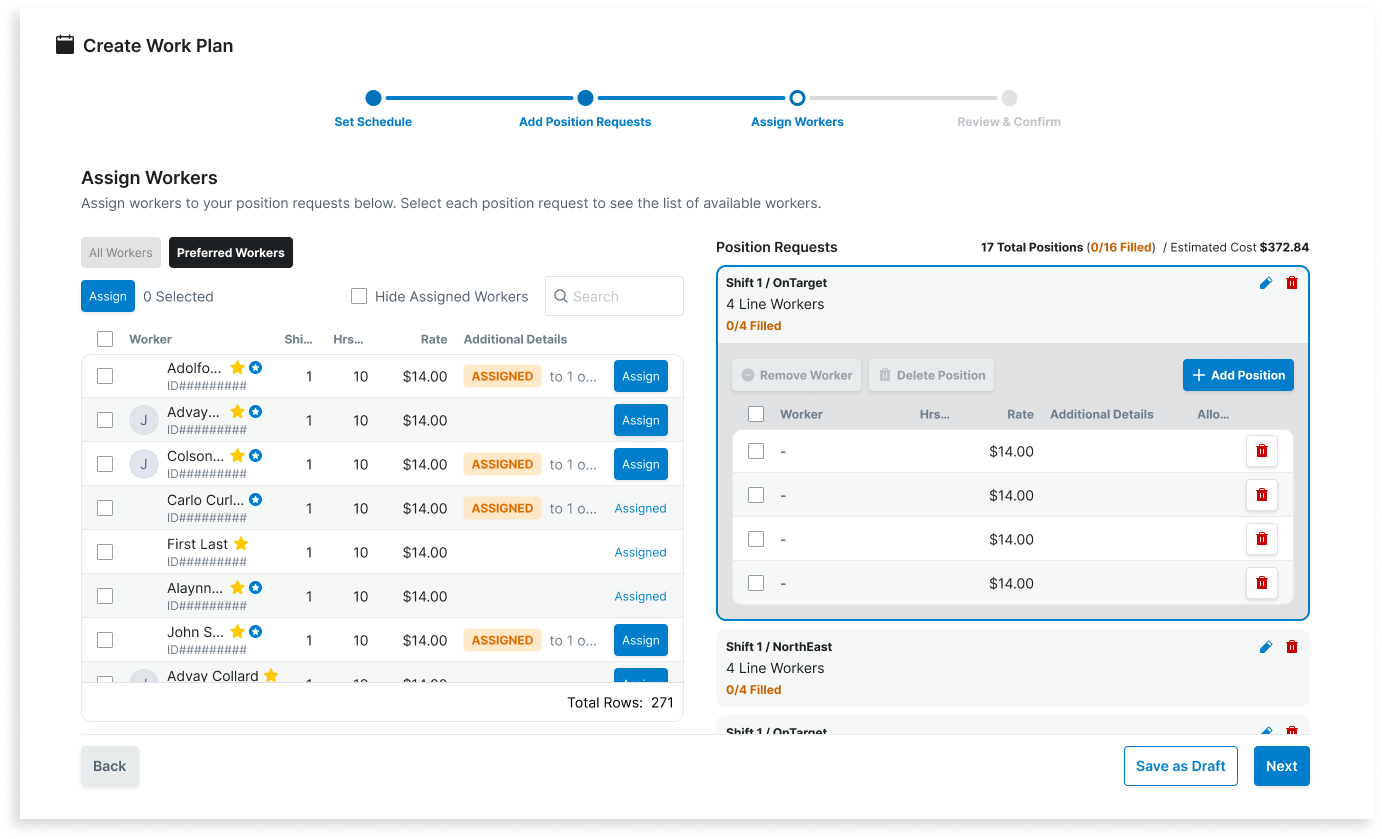
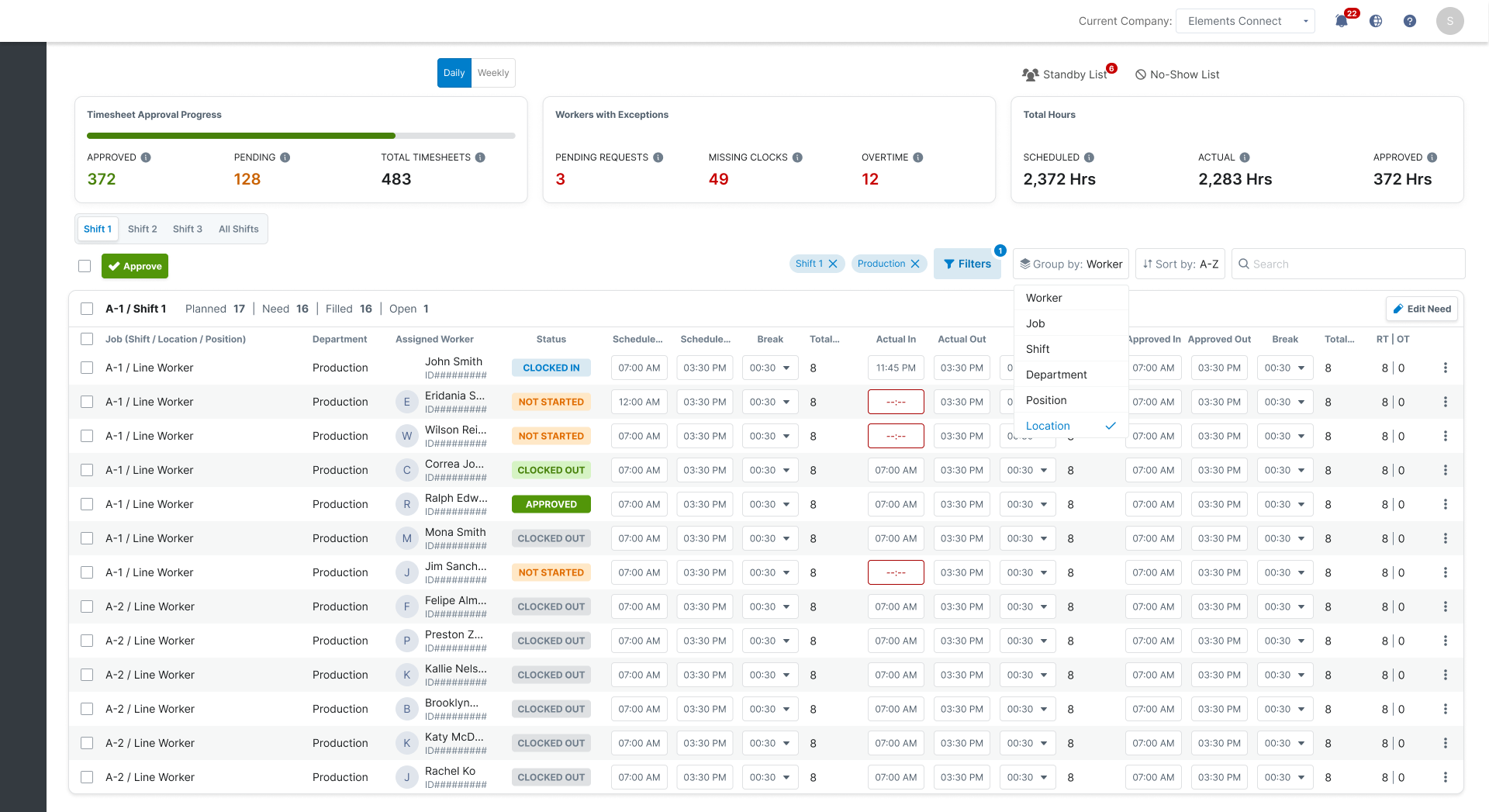
Root cause: staffing tools track assignments, workforce tools track shifts. No one owns the corrections and matching in between — where the time and money leak.

Design Goals

  1. Auto-build the plan. Let AI match work orders to POs and draft invoices, so a week stands up without hand-keying.

  2. Give every task an owner. Assign clear tasks so invoices don't get lost and exceptions get caught early.

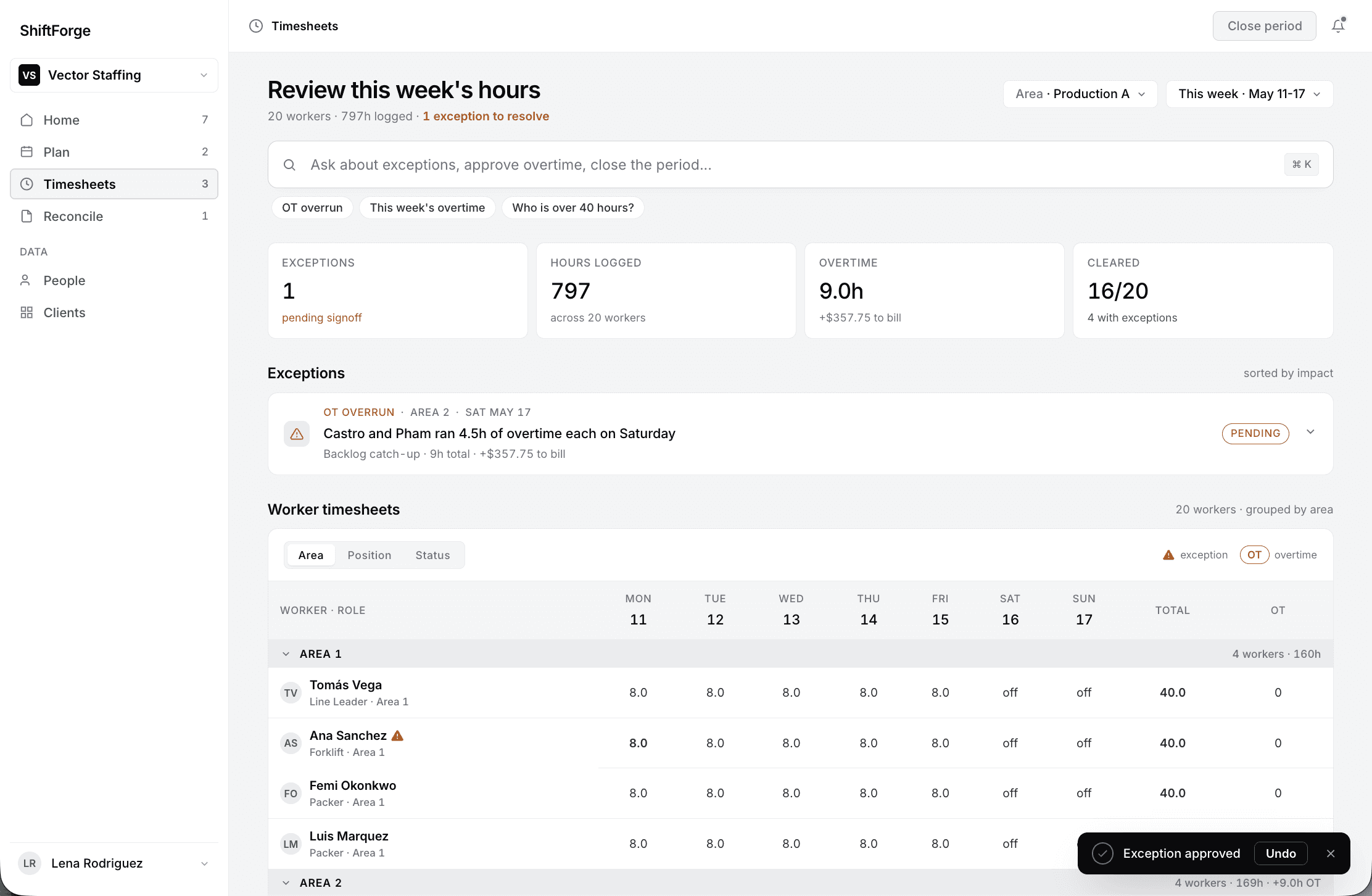
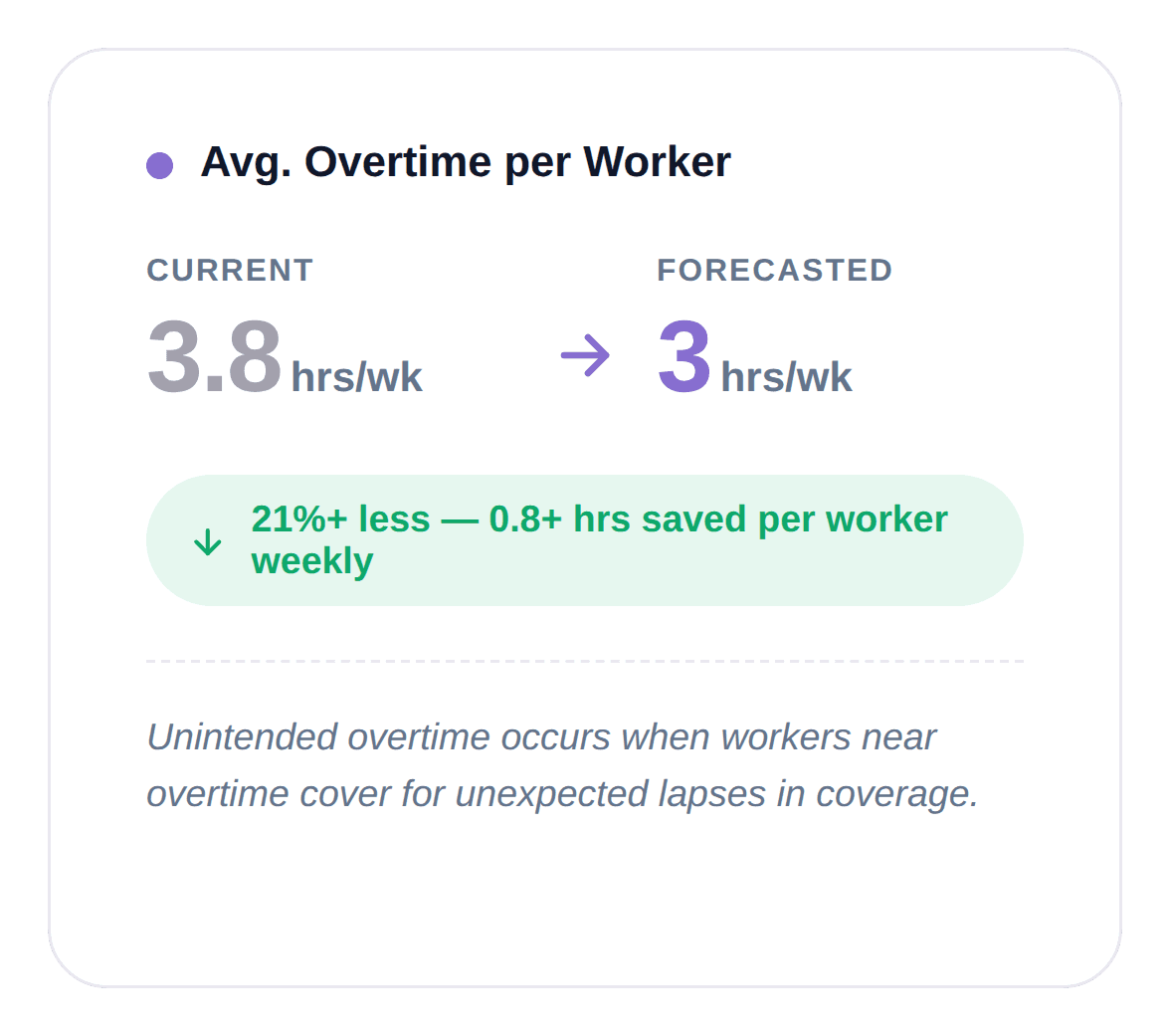
  3. Show overtime before it happens — at the moment of assignment, not on the invoice.

Outcome

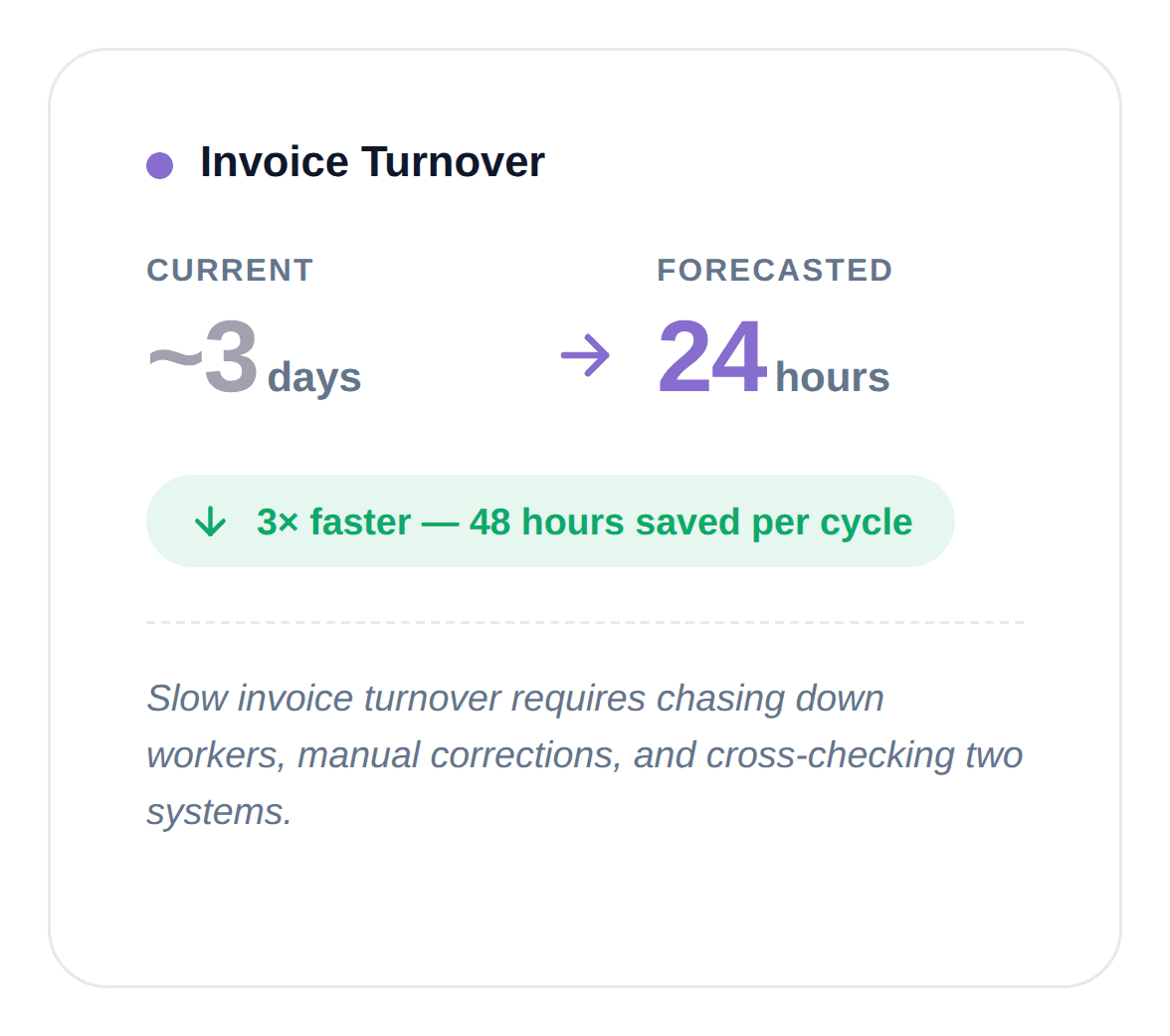
  • Planning setup down ~80% with auto-built plans

  • Reconciliation moves without chasing people, because the design always shows the next action

  • Surprise overtime designed out (~100%) by putting the OT forecast on the assignment card

Research

Competitive Analysis

Before designing anything, I wanted to understand this problem and how competitors approached it.

I scored the top 14 vendors in labor operations software on two things: how well they fit a factory floor, and how well they fit a staffing agency's economics. Not one of them scored well on both.

Vendor

Category

Staffing OS fit

Mfg WFM fit

Hybrid score

Bullhorn

Staffing OS

5 / 5

1 / 5

2 / 5

TempWorks

Staffing OS

4 / 5

2 / 5

2 / 5

Shiftboard

Mfg WFM

1 / 5

5 / 5

2 / 5

UKG WFM

Mfg WFM

2 / 5

4 / 5

3 / 5

ShiftForge

Orchestration layer

4 / 5

4 / 5

4 / 5

Gap Identification

Staffing tools track assignments: who's placed where, for what rate.

Workforce tools track shifts: who's covering what, for how long.

Neither covers the middle, where corrections and reconciliation happen. A hybrid solution does.

What that gap actually costs someone, every week

What that gap actually costs someone, every week

~4 hrs

~4 hrs

of a coordinator’s week, just reconciling timesheets by hand

of a coordinator’s week, just reconciling timesheets by hand

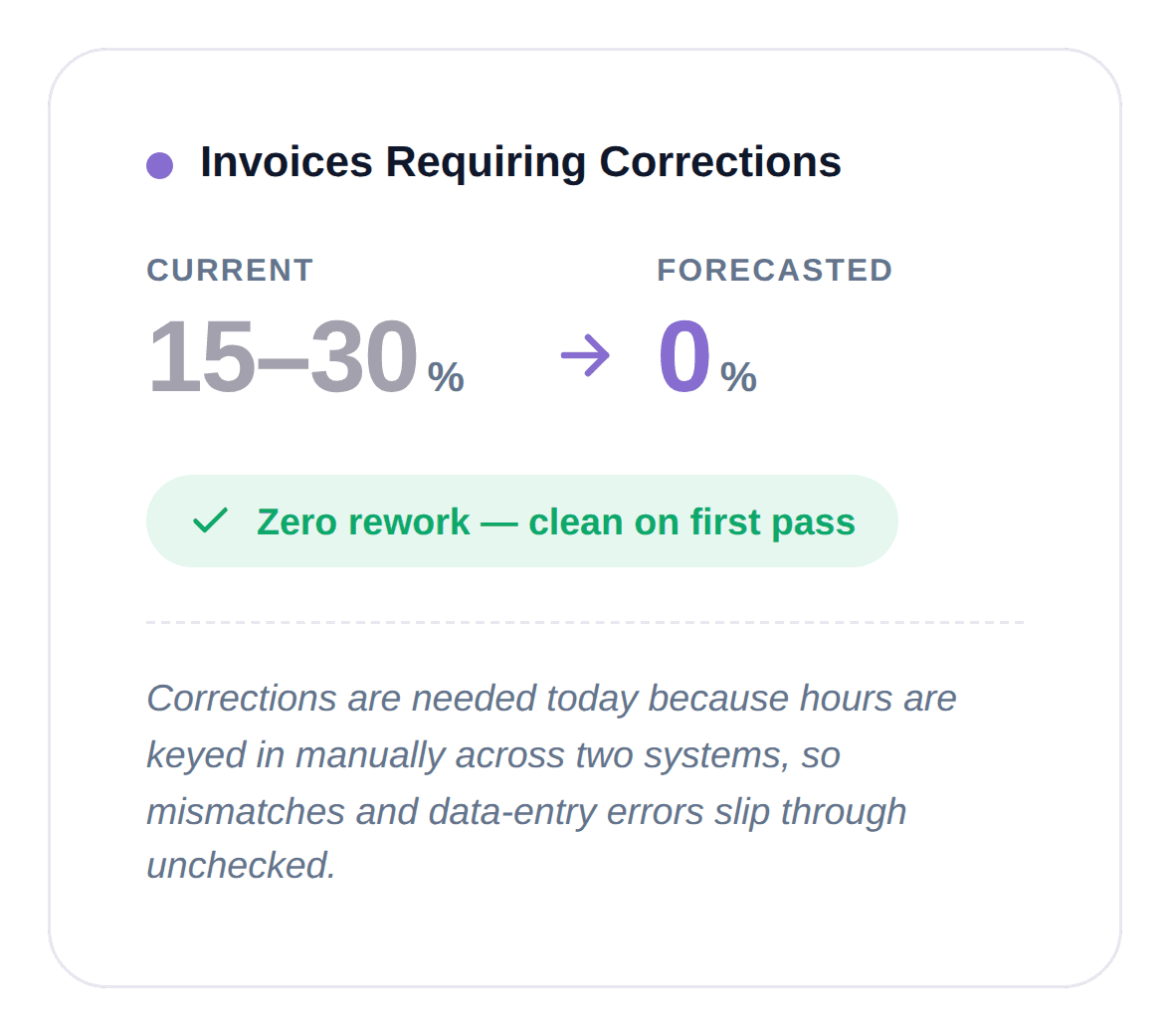
15–30%

15–30%

of invoices need a rate or overtime correction before they can even be sent

of invoices need a rate or overtime correction before they can even be sent

$48K

$48K

one customer wrote off in a single quarter — overtime caught only after it had already been billed

one customer wrote off in a single quarter — overtime caught only after it had already been billed

3–5 days

3–5 days

how long it takes to resolve a billing dispute over email, from memory

how long it takes to resolve a billing dispute over email, from memory

Design Process

Research

  • Conversations with staffing coordinators and plant supervisors

  • Mapped weekly workflows and pain points

  • Identified primary users and jobs to be done

Scope

  • Mapped user jobs to product features, grouped by role and approval boundary

  • Ranked by user impact and effort, cut to what could ship as v1

UI Design

  • Pulled UI references from operations and fintech tools

  • Studied approval and reconciliation patterns in adjacent products

Prototyping

  • Iterated through several rounds of HTML mockups, low-fi to high-fi

  • Landed on a single shared shell across planning, timesheet review, and reconciliation

  • Handed off to build with Claude Code in Next.js

Personas

Site Managers
Staffing Agency (On-site)

Behaviors: Planning, Assignments, Leading

Behaviors: Planning, Assignments, Leading


Goals: Keep plans up to date, High operational efficiency


Goals: Keep plans up to date, High operational efficiency


Pain Points: Missing timesheet data, Delayed invoice approval


Pain Points: Missing timesheet data, Delayed invoice approval

Supervisors
Manufacturing

Behaviors: Data driven decisions, Leading

Behaviors: Data driven decisions, Leading


Goals: Operational efficiency, Quality assurance


Goals: Operational efficiency, Quality assurance


Pain Points: Backfilling positions, Unexpected OT


Pain Points: Backfilling positions, Unexpected OT

If a temp worker goes into overtime, I don’t find out until the invoice comes.

If a temp worker goes into overtime, I don’t find out until the invoice comes.


— HR Manager · Staffing Agency

We approve time in one system, then re-enter it in another to generate the invoice.

We approve time in one system, then re-enter it in another to generate the invoice.


— Plant Supervisor · Contract Manufacturing Site

Why an agentic workflow

The operator's week is four repeating jobs across two software systems that do not communicate:

  • Onboarding a new worker

  • Assigning them to a shift

  • Backfilling when someone drops

  • Reconciling the invoice at week's end

An agent handles the exceptions that break basic automation.

The AI constraints I designed around

Hallucinated citations.

Made-up references. The agent sometimes cited time entries that did not exist, so I designed the app to checks every reference against the real data before showing it.

Version drift.

Inconsistent answers. The same question got different answers from different model versions, so I locked the answer shape to a fixed template the app checks against every time.

Over-narration.

Rambling. The agent wanted to write three paragraphs when one sentence was enough, so I capped the length in both the prompt and the app.

Fake confidence.

Guessing. The agent would confidently invent things it did not know, so I gave it a way to say "I do not know" and made that the only option when it was not sure.

Cost.

Cost per use. Paying a vendor for every question added up fast, so for the pilot the agent runs on the customer's own machine using a free open-source model.

Multi-agent design

The product runs three agents. Each has a bounded scope, a typed output, and a place where a human takes over.

Agent

Agent

Input

Input

Output

Output

Approval boundary

Approval boundary

Reconciliation Agent

Reconciliation Agent

This week’s time entries and rate cards

This week’s time entries and rate cards

3 to 5 typed flags with citations and proposed resolutions

3 to 5 typed flags with citations and proposed resolutions

Plant supervisor approves any flag that affects billing

Plant supervisor approves any flag that affects billing

Coverage Agent

Coverage Agent

Next week’s demand and the current roster

Next week’s demand and the current roster

Coverage flags, ranked candidate suggestions per open shift

Coverage flags, ranked candidate suggestions per open shift

Staffing coordinator dispatches, supervisor confirms

Staffing coordinator dispatches, supervisor confirms

Workspace assistant

Workspace assistant

The active surface plus the palette query

The active surface plus the palette query

Free-form chat scoped to the current view

Free-form chat scoped to the current view

Never moves state, only proposes

Never moves state, only proposes

None of the agents can decide anything on their own. They can suggest, they can show their work by pointing at the exact time entries and rate cards they read, but the final approval always belongs to a person.

How I used Claude

On the build. Claude Code handled the technical scaffolding: page routing, design tokens, automated tests, and the local-file agent pattern.

On the design. In the browser, I used Claude to review other products' patterns, test early prototypes against them, and pull in supporting data during research.

On the method. My usual rhythm applied with Claude at each step: discovery, framing, exploration, prototyping, testing, and handoff.

Key Solution

The five AI capabilities that make it work

Agentic dispatch

Agentic dispatch

Assign work without lifting a finger

When a shift needs coverage, a recommendation algorithm ranks available workers across every connected agency — by certification, availability, cost, and distance — and hands a supervisor a ranked shortlist with the reasoning attached, not just a name.
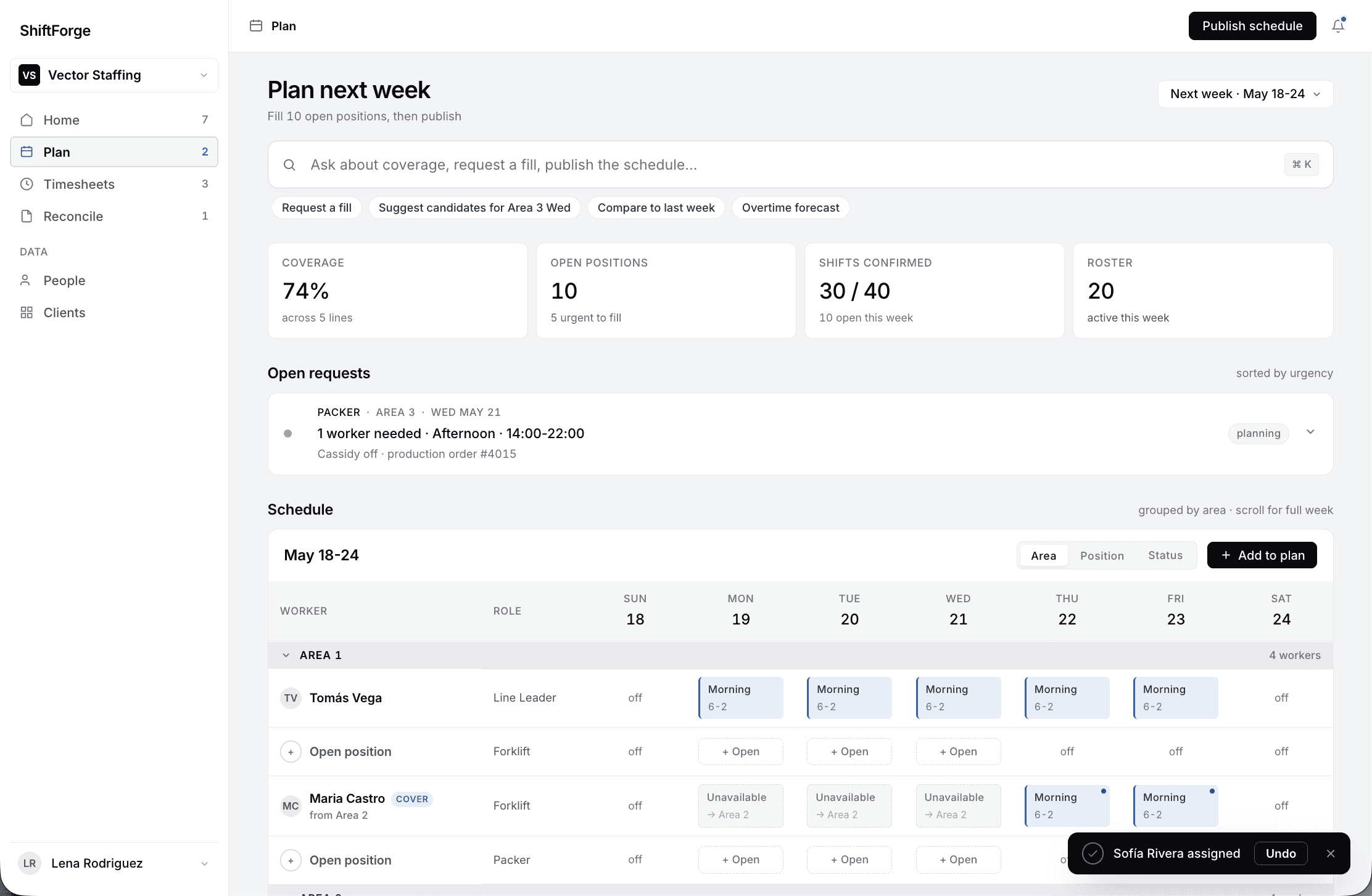

Why it's needed: supervisors told us they often can't even tell which agency a worker on the floor belongs to. Dispatch and cost had to live in the same place.

Human-in-the-loop exceptions

Human-in-the-loop exceptions

Human approval when it matters

Overtime, missing punches, geofence issues — all flagged automatically, with a proposed fix attached. But nothing touches pay or a worker's record until a named person clicks approve.
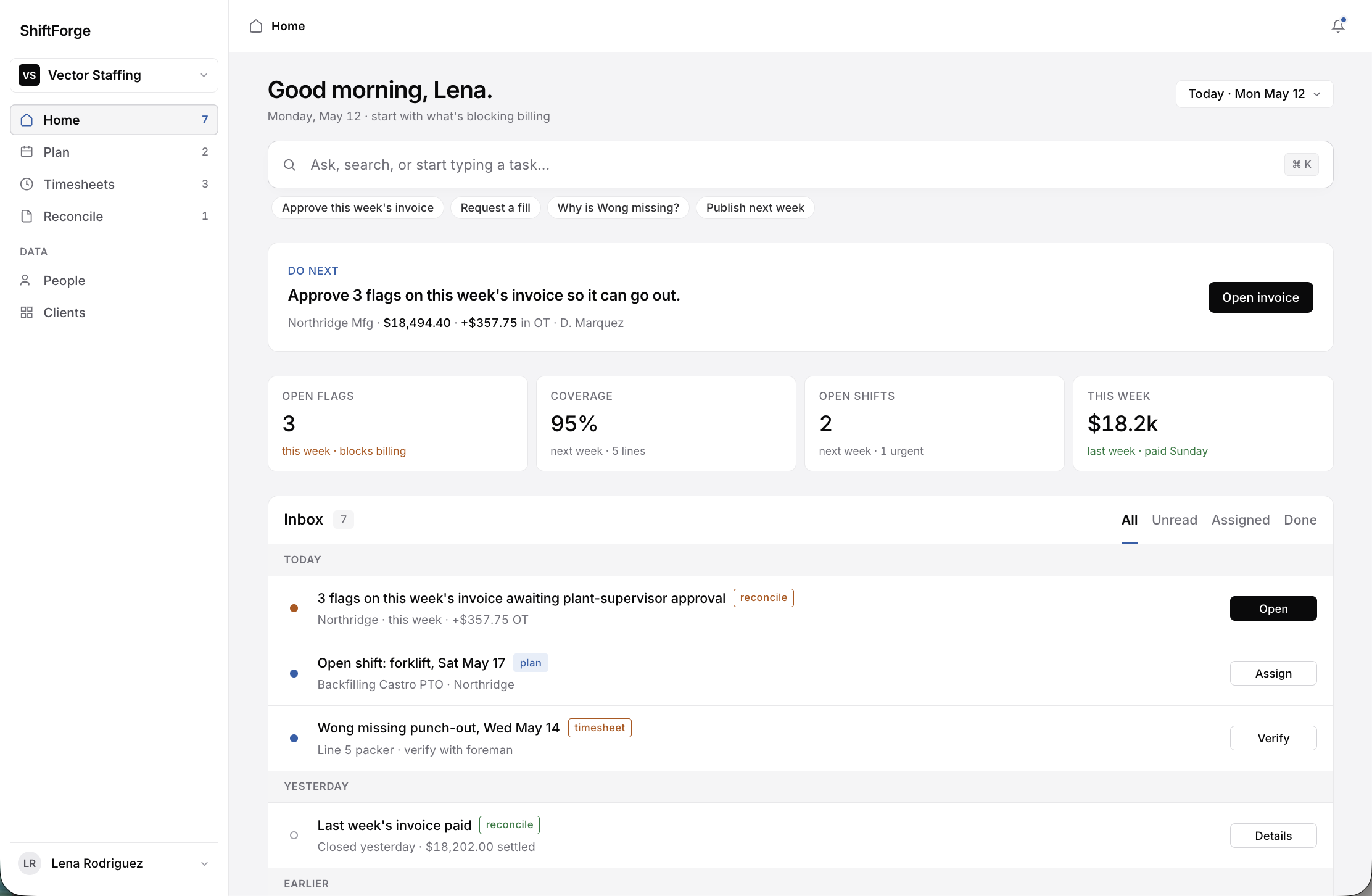

Why it's needed: every dispute we heard about started with someone finding out too late to have a say. This puts the say back in, earlier.

Intelligent OT forecasting

Intelligent OT forecasting

Take action before it's too late

The moment a worker crosses the overtime threshold, it's flagged — not discovered a week later when the invoice lands and it's too late to plan around.


Why it's needed: one customer wrote off $48K in a quarter on overtime they didn't see coming until the bill arrived.

RAG-grounded invoicing

RAG-grounded invoicing

Accountability that highlights exceptions

Before the agent writes a single word of an invoice, it retrieves the real timesheet, rate card, and policy behind that line. It explains what it already looked up — it can't invent a number it can't point to.


Why it's needed: 15–30% of invoices needed a correction before shipping. The fix had to be grounding, not better writing.

Audit trails

Audit trails

Keep track of how it all happened

Every flag carries the evidence behind it. Every approval is logged with who, when, and why. Every action can be reversed by a person with the right permissions.
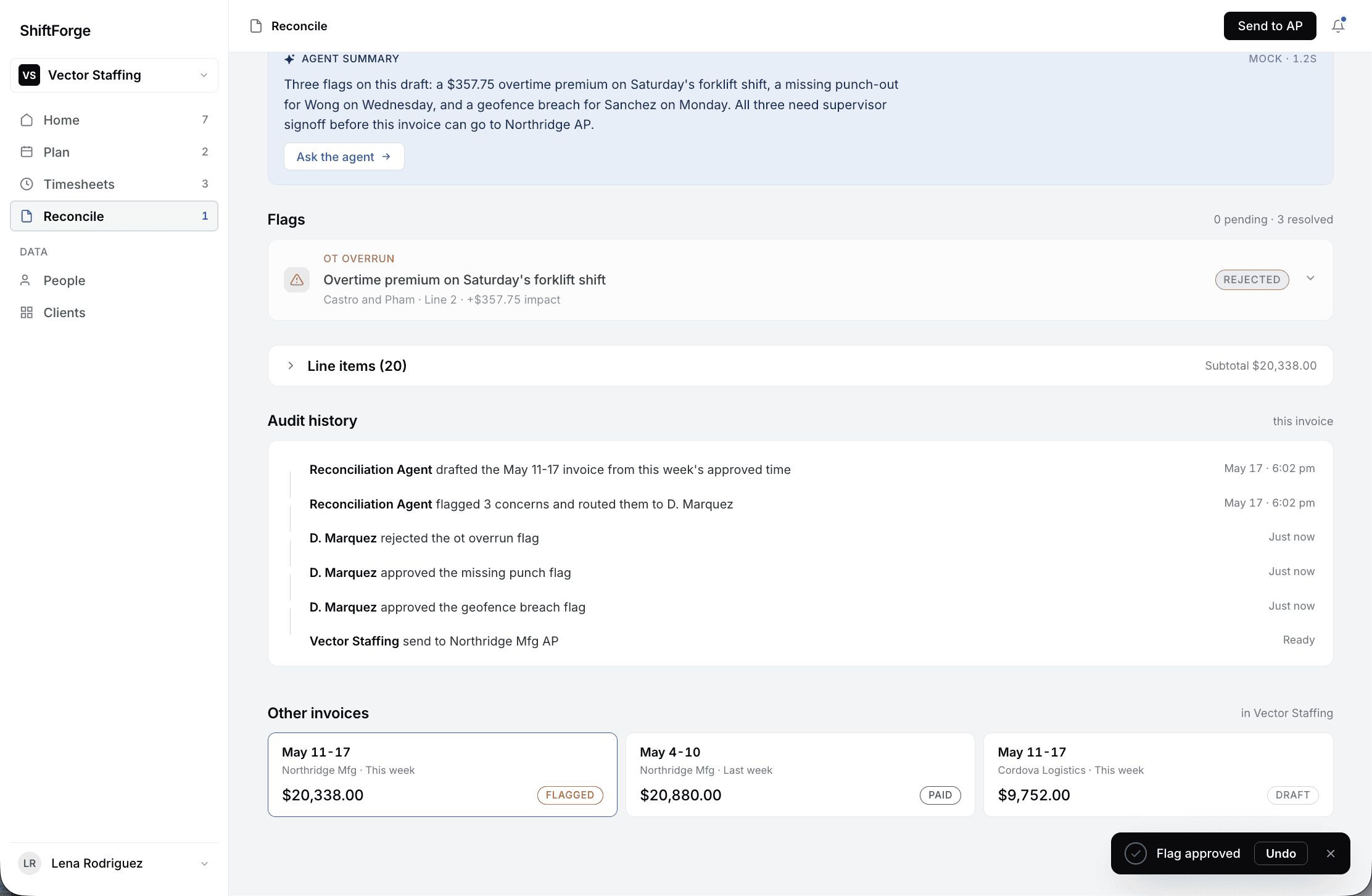

Why it's needed: today, disputes get settled by memory and email. That's the opposite of a record.

Metrics

I ran multiple simulations with agents and compared the result against the baselines collected from prior user research. The number looks promising, but we need to conduct further testing on staffing agencies in real-world environments.

Next steps

Next step is signing a small group of staffing agencies and manufacturers as design partners. Running the product against their actual weeks is how we measure overtime caught before it billed, hours cut from the invoicing cycle, and follow-ups on exceptions and reconciliations avoided.

aerial view of vehicles in parking area