Material Exchange
I led design with a small team to create and launch beta for Material Marketplace, letting manufacturers buy and sell excess materials — reducing waste by finding buyers for ingredients below minimum-order quantities. Redesigned in 2026 from beta learnings.
Two competitors will trade with each other — but only if nobody can tell who is buying or selling what.
Manufacturers over-buy raw materials constantly.
If a project or a contract was terminated, the excess takes up space in a warehouse only to be disposed of at a loss. But other manufacturers may need those exact materials.
Disposing of unused materials can cost up to $250 in disposal charges and an additional $150 in logistics — for inventory someone else would have paid for.
Project 1
Project 2
Project 3
Project 1 · consumed
Project 2 · consumed
Project 3 cancelled
Excess, up to $400 to dispose
If I could tell my only buyer was a competitor who needed it, what stops me from marking the price way up?
Our design partners formed to cut losses, not to profit off each other, so fairness mattered as much as secrecy. The core tension: these competitors were willing to trade, but only if nobody could tell who was buying or selling what.
Excess is pure loss
Terminated contracts leave raw material taking warehouse space, then cost up to $400 to dispose of.
What you buy is a secret
Participants are direct competitors — their material list reveals formulation and roadmap.
Fairness beats profit
Partners formed the group to cut losses, so visible demand could be used to mark prices up.
A focus group study confirmed they all had the same issue
I conducted interviews and began observing transactions as we built a strategy to approach this problem.
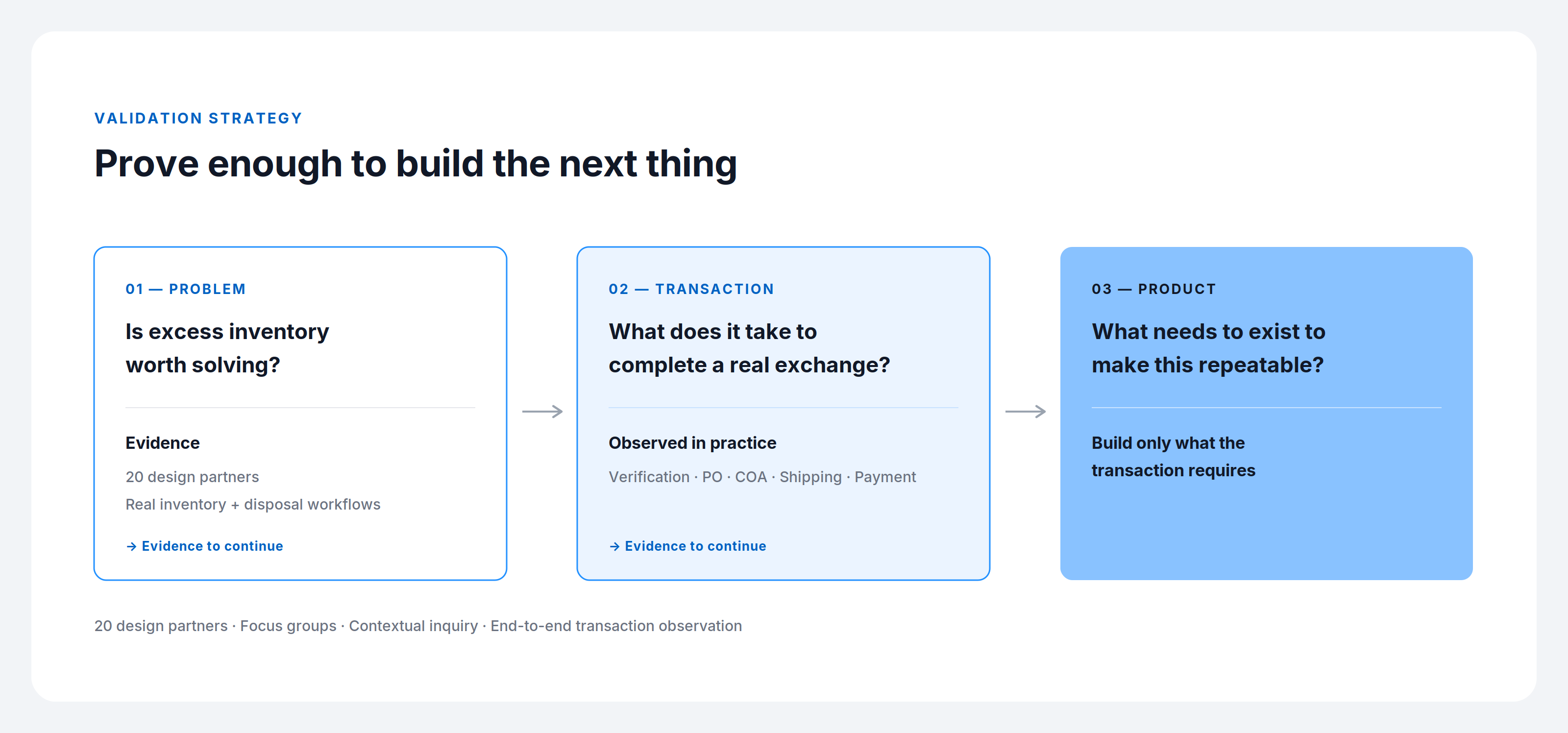
Observing transactions first hand allowed insight into the process
As we facilitated transactions, I was able to observe and interview everyone involved as the material changed hands until completion.
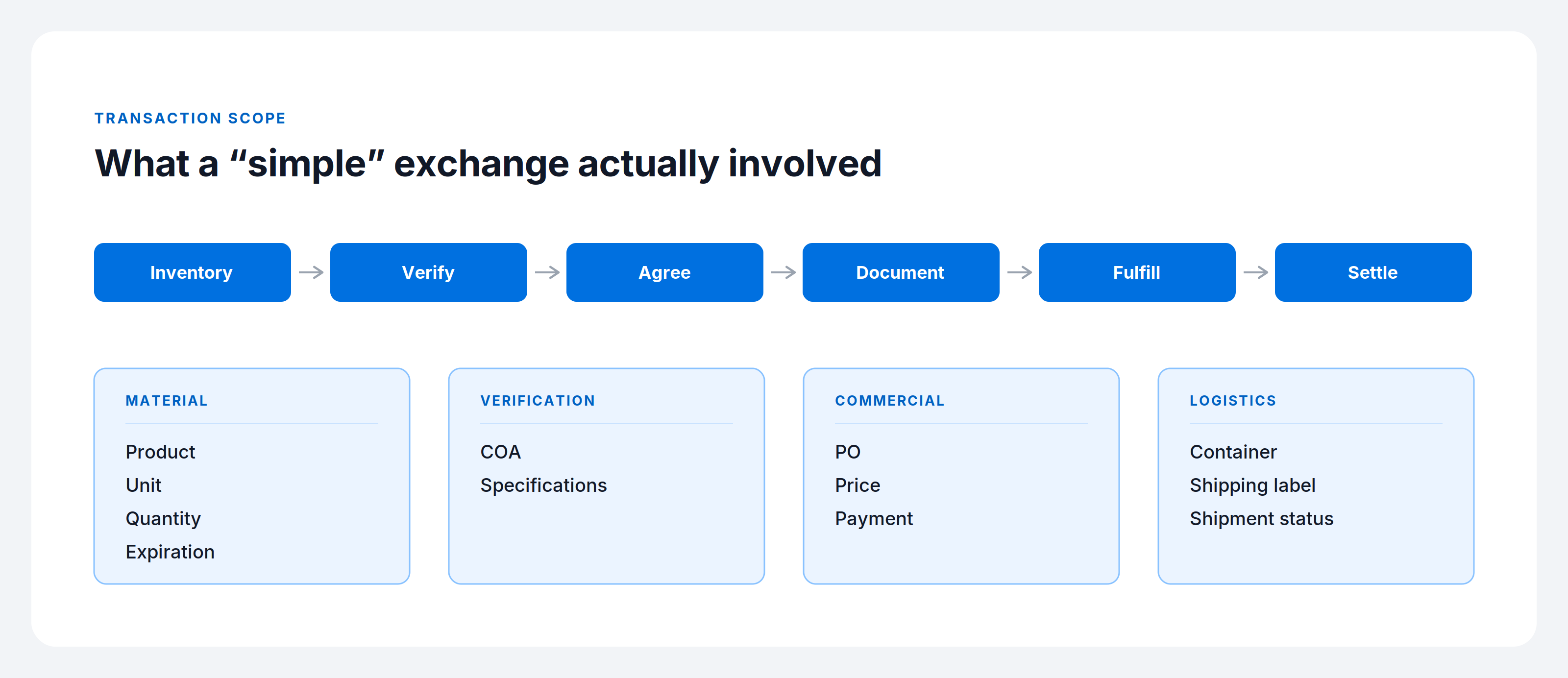
What the research set as requirements
- Identity must stay hidden through discovery, negotiation and payment — revealed only where logistics forces it.
- A neutral middle party has to hold funds until delivery is confirmed.
- Sellers disengage fast when they are asked about materials they do not hold.
Running the exchange over email
What's the cheapest possible version of an anonymous exchange? Email, with us in the middle. A survey only proves what people say they'd do; a real deal proves everything. So we became the exchange: someone asks for a material, it goes out to the group as “Participant A needs X,” and we relay everything in between.
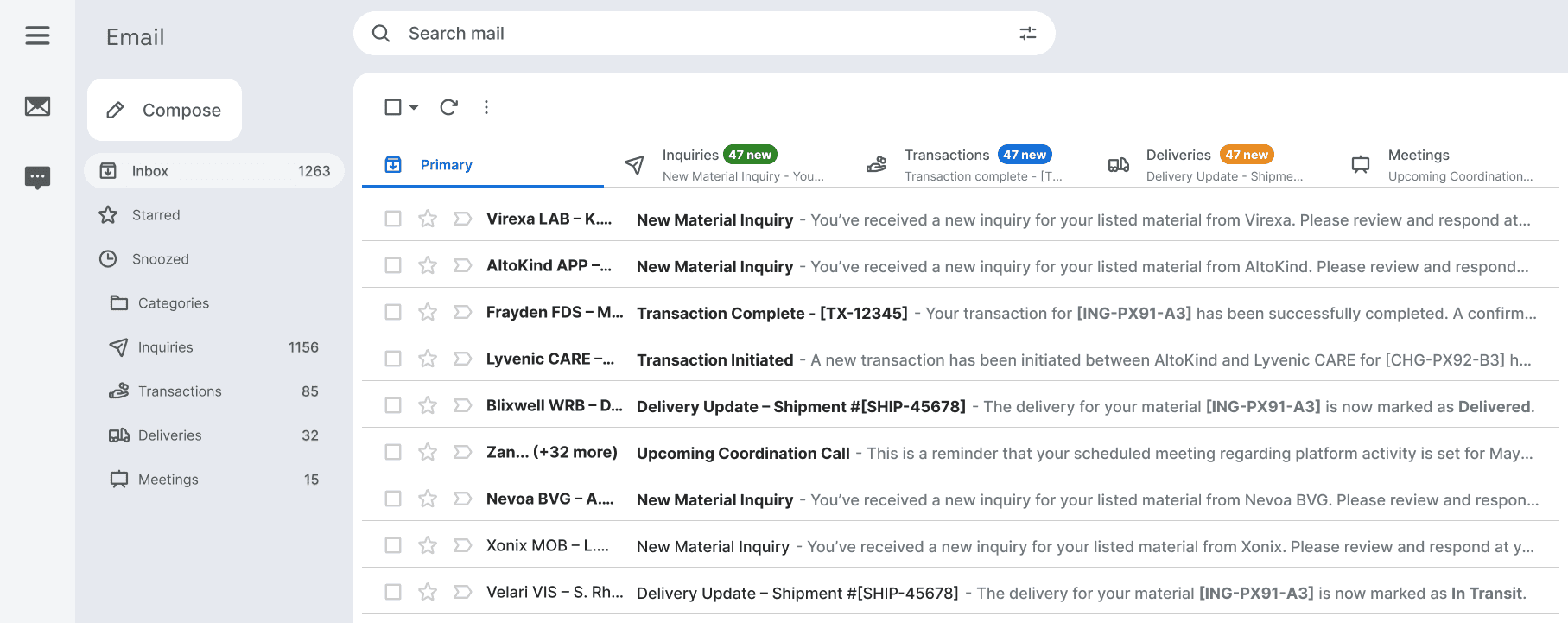
The demand was real: people negotiated prices, produced the paperwork, and trusted us to hold money until delivery. But ~95% of inquiries hit sellers who couldn't help, and the more noise they got, the less they replied.
The inquiry platform
We knew the marketplace was the destination. So why didn't I build it first? Because the only thing validated was that anonymous deals close — not that anyone would publish inventory.
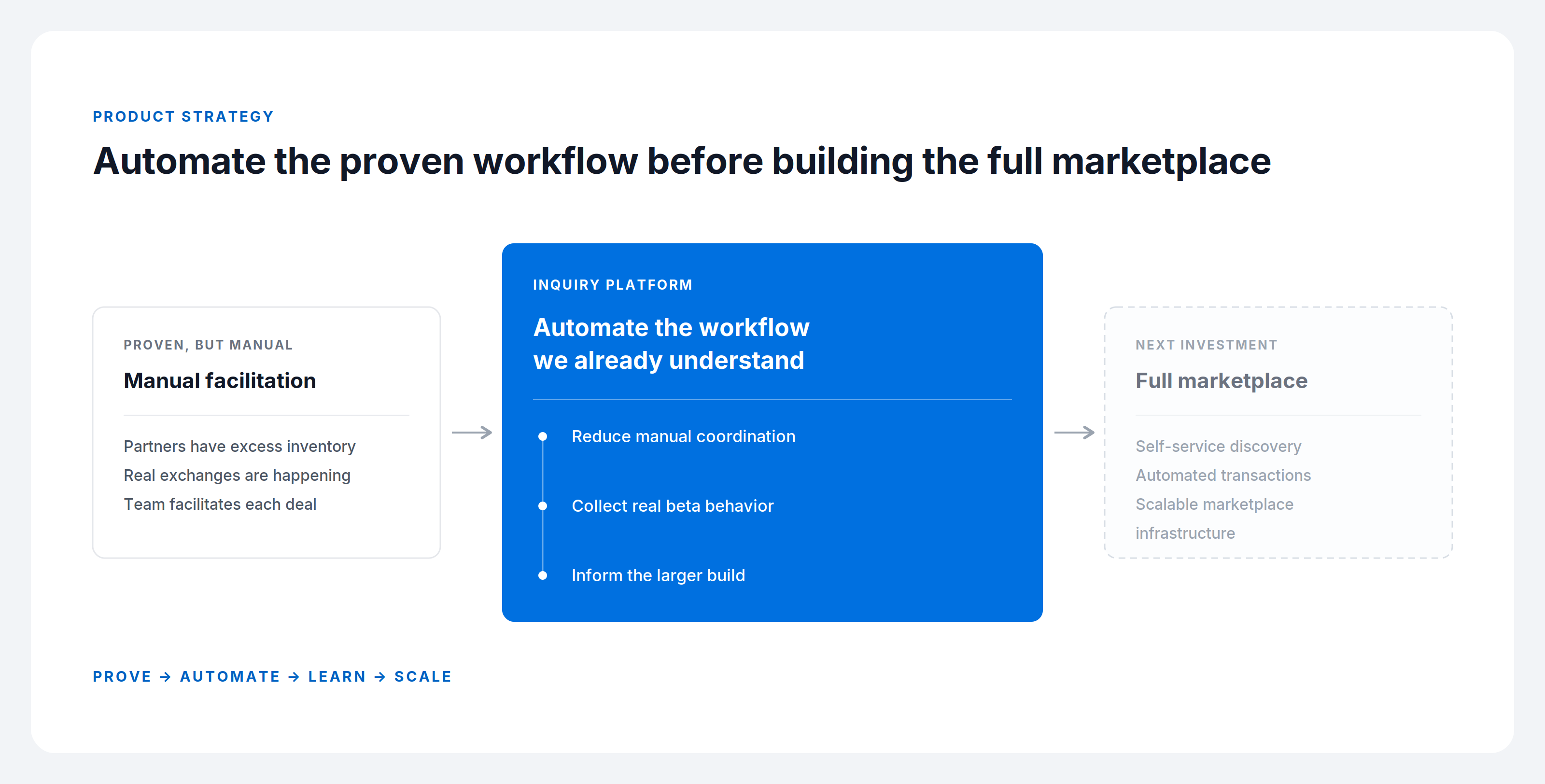
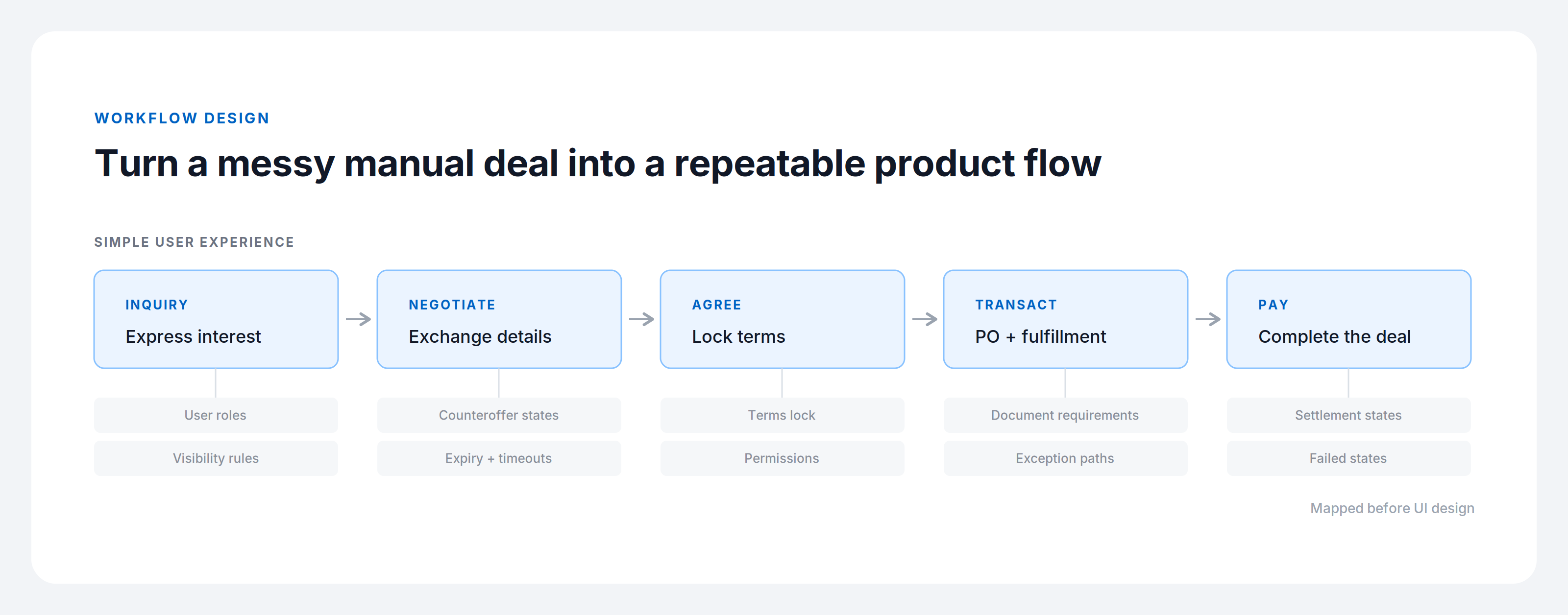
I mapped the user journey and flow for inquiries, transactions, and payments
I considered happy paths and the edge cases for messy situations — which set the standards, design, and architecture for the site.
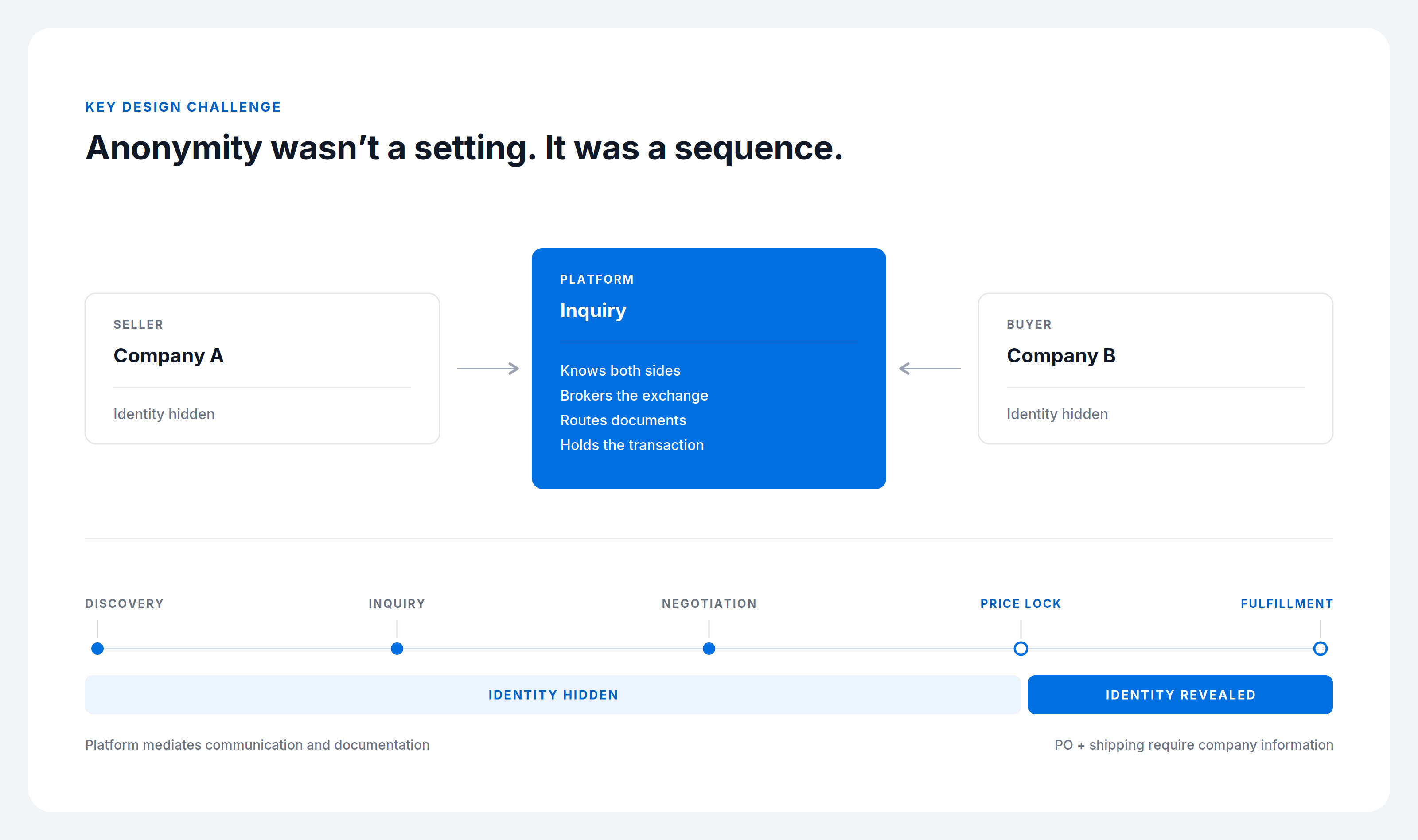
The hardest design challenge was anonymity
You can't hide everything, since a shipping label needs a real address. So anonymity works as a sequence — each party learns only what the next step requires.
Let's see the inquiry platform design
Six months of beta data, and a structural flaw
Within 6 months, users each saved an average of $4k in potentially wasted supplies, preventing ~2 tons of product from entering landfills. People came back and traded again. But engagement wasn’t growing.
Customers
Transactions
Saved / customer
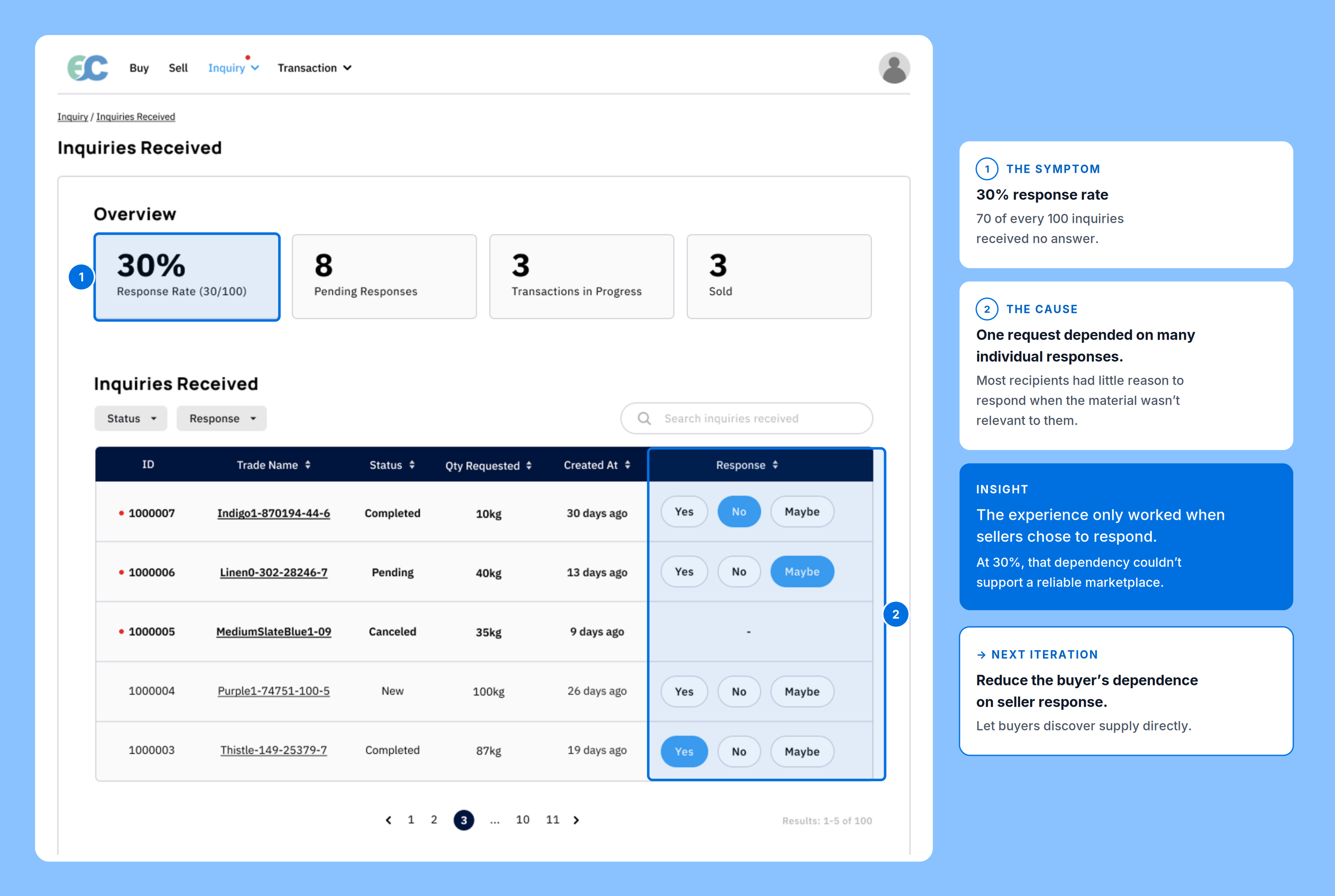
The flaw was structural. Ask 20 people for a material and most say nothing. Once buyers stop trusting they’ll get an answer, the whole thing loses its value. No UI polish fixes that. We got anonymity right — identities stayed protected and deals still closed — but buyers had no reference to what inventory was actually available. Every inquiry was a question in the dark.
It would be much easier if I could upload a CSV of my available excess inventory.
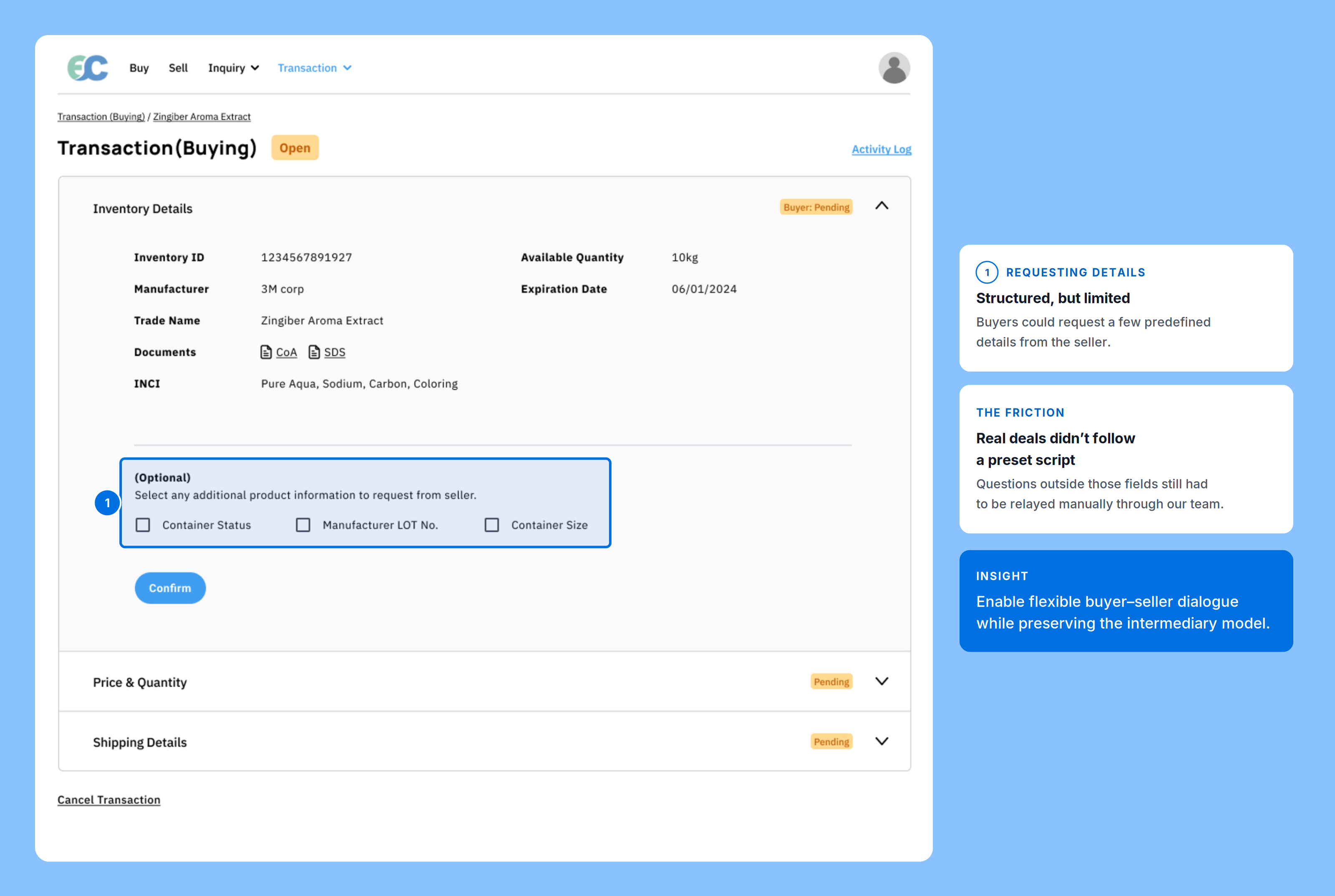
Deals were slow for a related reason: buyers and sellers couldn't just call each other, and we hadn't built chat to replace that. It wasn't easy to accept that our most successful build had this flaw — but now we knew exactly why it failed and what to build instead.
Redesign as a marketplace
This stage is solo work: I designed and built a functional, industry-agnostic prototype, with AI handling the engineering. The core change flips who does the work. Instead of posting inquiries and waiting, buyers search real inventory that sellers have listed anonymously. Sellers only do the work once.
Making materials findable
Search by SKU, standard name, or INCI, narrowed by industry, category, and function — a buyer who only knows what a material does can still find it.
Handling orders and partial sales
Orders carry through inquiry, processing, negotiation, shipping, and completion in one flow, with real-time chat replacing the phone call anonymity took away. To handle partial requests, an active order reserves only its quantity — the rest stays on the market as its own listing.
Structuring organization accounts
Role-based permissions split the work — executives oversee operations, account managers run deals from a sales dashboard, and warehouse staff bulk upload and draft listings, with admin approval determining what goes live.
We need to be careful with including new participants, as they need to understand our policy, anonymity and fair trade agreement.
Vendor registration upholds these values: verification, a user agreement, and vetting before anyone is invited to list. The company never shipped this — priorities shifted, and I carried the vision forward on my own.
Two builds, one validated model, and a clear reason to change it
Transactions
Total traded
Waste prevented
The email POC proved anonymous deals happen with nothing built. The inquiry platform turned that into 100+ transactions and ~$80K traded in six months — but every deal depended on sellers answering inquiries for materials they mostly didn’t have.
Both systems directly shaped the marketplace’s design: the parts that worked carried over, and the failures dictated what had to change. If it works, responses go up, waits go down, and sellers stay engaged because listing once is all it asks of them.
The call I’d redo is treating “inquiry vs. marketplace” like an either-or
A middle option was sitting right there — sellers add a few inventory keywords, get pinged only on matches. That could have fixed engagement months earlier for far less. What I’m proud of is that we never bet more than what we had validated.
Next steps
- Run usability tests on the marketplace prototype with real clients.
- Track inventory uploaded, transactions closed, and what testers say about material discovery.
- Build out vendor registration in detail — the original partners had strict requirements for admitting new participants.